ZION NATIONAL PARK
Situated in Southwestern Utah,
Zion National Park is the state of Utah's oldest and most popular national park. The word Zion is from ancient Hebrew and means "place
of peace and refuge." Visitors to this immense series of canyons, beautifully sculptured rock formations, dramatic vertical cliffs and
breathtaking landscapes will agree that Zion National Park is one of the greatest scenic attractions in America. Zion has recently been recognized by Trip Advisor as America's number one national park.
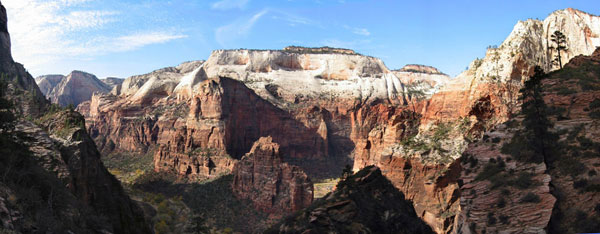
The many canyons of Zion were formed
over centuries of erosion caused by tributary flowing streams that lead into the Virgin River. The Virgin River is the main flow of water that has carved the most famous section of the park, "The Zion Narrows". Zion National Park covers a large geographic area and is approximately 30 miles in length and 15 miles across at it's widest point. There is a large number of birds, animals and plants that exist in this park that ranges in elevation from 3,800 feet to 8,700 feet. Most visitors to the main canyon area of Zion National Park will experience elevations between 4,000 and 6,500 feet.
Zion National Park was originally occupied by an ancient group of people called the Anasazi. These people spent about 1,000 years in the region and then mysteriously abandoned their cliff
houses and rock art that are still found scattered throughout the park. Following the Anasazi, the Paiute Indians came into the region around Zion National Park. The
first Mormon pioneer settlers visited the Canyons of Zion in 1858. They called their new home Zion Canyon and biblical names were given to many of the formations within the park. In 1872 John
Wesley Powell surveyed the region and recorded the canyon's Native American name of Mukuntuweap. It was under this name that the
area was first designated a national monument in 1909. Nine year later, in 1918, the park was renamed Zion National Monument and the next year (1919) it
received official national park status.
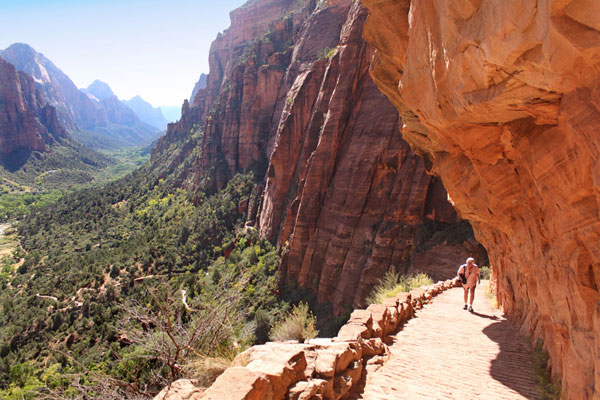
One of the early visitors to Zion Canyon was an artist by the name of Frederick S. Dellenbaugh who spent part of the summer of 1903
painting in Zion Canyon. His paintings were exhibited at the 1904 St. Louis World's Fair. In January of that same year
Dellenbaugh then published an article about Zion National Park in Scribner's Magazine. The article, which was titled "A New Valley of Wonders,"
described Dellenbaugh's first glimpse of the Great Temple, which stands within Zion National Park.
"One hardly knows
just how to think of it. Never before has such a naked mountain of rock entered our minds. Without a shred of disguise
its transcendent form rises pre-eminent. There is almost nothing to compare to it."
Zion National Park is host to a broad collection of geological wonders, including formations such as the park's most famous landmark; the towering
2,200-foot Great White Throne. Other formations with colorful names include the Court of the Patriarchs, the Sentinel, the Watchman, and
Checkerboard Mesa. Kolob Arch, within Zion National Park is 310 ft. long arch and rated as one of two of the world's largest known natural spans of rock. The Narrows of the
Virgin River, is a remarkable water-course where a person can walk upstream or downstream to narrow places where the canyon walls extend hundreds and even thousands of feet upward. .
Zion National Park has two visitor centers, one at the entrance to Kolob Canyon (via I-15) and the main visitor
center at the south entrance to the park at the town of Springdale.
|